
Correcting an Eagle Record Gap
When Eagle records disagree, identify which office owns the disputed field. EPD owns the event narrative. The jail owns custody entries. Municipal Court owns its town docket. Eagle Combined Courts owns state-case charges and outcomes. CBI owns the compiled fingerprint-supported history it received. Sending one general request to every counter can produce several partial answers without correcting the source.
For an unknown CBI disposition, request the official disposition or sentence order from the filing court and use CBI's update channel. A register of actions can help establish the case history, but the signed outcome order is often the clearest proof. If the problem is a false or common-name match, a fingerprint-based personal review is stronger than paying for repeated name searches with small spelling changes.
Keep the EPD report number, jail booking identifier, municipal citation, and state court case number separate. Each belongs to its own system. Colorado case numbers combine a year, class, and sequence. Classes such as CR, M, T, and R help narrow a clerk search, but they do not state the exact offense or final judgment. Read the filed charge and disposition rather than guessing from the code. This method gives the custodian enough proof to investigate the actual error.
Eagle Criminal History Checks
First decide whether the record began with Eagle Police, Eagle Municipal Court, the county sheriff, or a state court. Eagle Police Department, or EPD, keeps its incident and arrest reports. The municipal clerk keeps town-code and local traffic cases. Eagle Combined Courts keeps felony, state misdemeanor, and state traffic files. The jail records custody, and CBI compiles fingerprint-supported statewide history.
Follow five direct steps:
- Request the EPD report when Eagle officers handled the event.
- Contact Municipal Court for a town citation or ordinance case.
- Search the Eagle County docket and request the ROA or filed documents for a state case.
- Check the county Jail Viewer for booking and custody details.
- Use CBI ICHC for a Colorado-wide, name-based history search.
Do not treat a hearing listing as a judgment or an intake charge as a conviction. Each file records a different stage. A missing CBI disposition may mean the final result was never matched, not that the court left the case unresolved.
Eagle Broadway and Chambers Counters
Eagle's justice geography is unusually compact and unusually easy to confuse. Town Hall, EPD, and municipal records operate at 200 Broadway. The Eagle County Justice Center, sheriff, jail, District Court, and County Court are at 885 Chambers Avenue. The District Attorney works from the Justice Center Annex at 955 Chambers Avenue.
A Broadway request asks what the town did. A Chambers request asks what the county or state court did. A single Eagle arrest can create an EPD narrative at Broadway, a booking record at the jail, and a court case at Chambers. Neither counter can simply replace the others. This local split is the most useful fact to settle before searching.
Records at the Eagle Police Department
EPD offers report requests, accident reports, fingerprinting, civil services, and VIN work. The department is at 200 Broadway, PO Box 609, Eagle, CO 81631. Call 970-328-6354, fax 970-328-5203, use nonemergency dispatch at 970-479-2200, or email epd@townofeagle.org. Town instructions distinguish police records from general town records, so describe the requested police event clearly.
The official Town of Eagle public-records page shows the current request route.
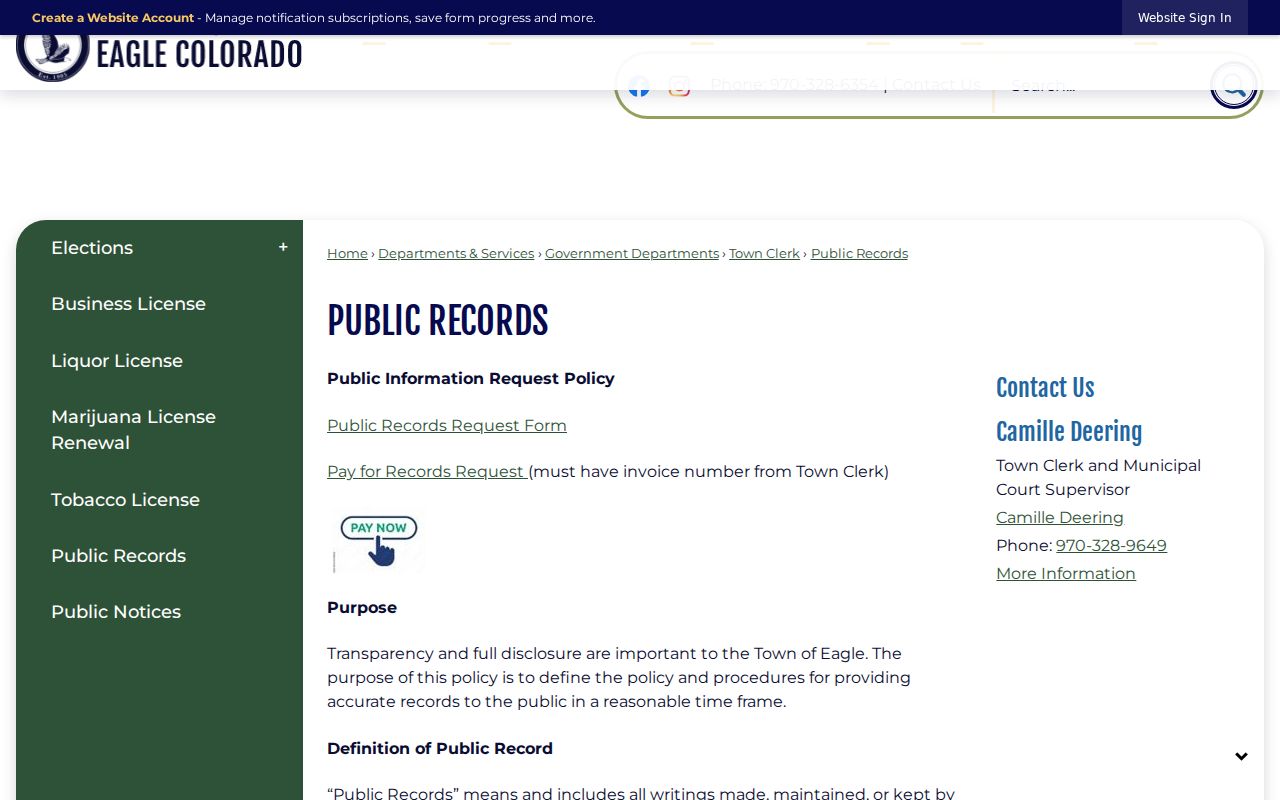
Include the date, location, names, and report number if known. For a court request, the town specifically asks for the defendant's name, date of birth, and year. Precise clues reduce time spent searching records with similar names.
Eagle Police Records Work Separately
The town's general form lists several departments, including Police and Municipal Court, and asks for identity, contact information, request date, address, a commercial-use answer, narrative, policy agreement, signature, and delivery choice. Yet an EPD report remains a criminal-justice record. Use the police route for the officer narrative and the court route for filed municipal documents.
The published 2025 research rate is $41.37 per hour after the first free hour. The usual response time is three working days, with a possible seven-day extension. Those timeframes do not promise release of every item. CCJRA still permits redaction or withholding where victims, minors, an active investigation, sealed data, or another protected interest is involved.
A focused narrative can save research time. State the record type, date range, location, named person, case or citation number, and preferred delivery method. Ask whether the first free hour is likely to cover the search. If the requested item is really a filed court document, redirect it to the clerk instead of paying for police staff to confirm that another office holds it.
Booking and Arrest Records in Eagle
EPD creates the local arrest report, but Eagle County jail creates the booking record. The Jail Viewer can be searched by name, booking number, custody status, and booking or release date range. Its percent-sign wildcard can help when spelling is uncertain. The public profile may show booking date, status, intake charges, bond information, and facility details.
Those fields do not prove guilt. The prosecutor may amend or decline charges after intake. Search Eagle Combined Courts for the filed case and final disposition. If EPD did not make the arrest, request the report from the agency that did. CBI states that it does not keep another agency's narrative arrest report.
One Eagle Arrest, Three Records
A common mistake is expecting the same facts in every database. EPD describes the event and officer action. The jail documents intake and custody. The court file records the formal charge, hearings, plea, orders, disposition, and sentence. CBI receives a fingerprint-supported arrest cycle and later disposition data when agencies report and match it.
Timing explains many apparent conflicts. A booking entry may appear before the prosecutor files. A court outcome may exist before CBI shows it. If ICHC lacks the disposition, obtain an official outcome from Eagle Combined Courts and submit it through CBI's update process. The Eagle County court case lookup gives fuller detail on court files and request fields.
Names can also create false links. Use an exact legal name and date of birth for ICHC, but do not add a suffix because the portal directs users to omit Jr., Sr., I, II, and similar terms. An optional Social Security number may aid matching. Known maiden or alias names require separate paid searches, so begin with the identity tied to the event.
The Eagle Municipal Court File
Eagle Municipal Court handles town ordinance and local citation matters. It is separate from District Court and County Court even though all operate in the county seat. No public online municipal case search was located in the research. Contact the clerk at 970-328-9649 or court@townofeagle.org and give the defendant name, date of birth, and case year.
| Court Name | Town of Eagle Municipal Court |
|---|---|
| Case Types Heard | Municipal-code and town citation matters |
| Case Lookup Channel | Municipal clerk by phone, email, form, or counter |
| What the File Shows | Citation, settings, plea, orders, judgment, and payment data when maintained |
| Copies & Fees | $41.37 hourly research rate after the first free hour, subject to current town policy |
A town e-bike citation is a useful example. Eagle's 2024 ordinance created local equipment, yielding, and location rules. A local enforcement event should not be confused with a statewide criminal-history entry merely because a uniformed officer issued it.
Eagle E-Bike Rules Show Venue
Municipal ordinances show why the underlying law matters as much as the officer or location. Eagle's e-bike provisions are locally enforced. The resulting town citation belongs with Municipal Court. By contrast, a state misdemeanor or felony moves to County or District Court at Chambers Avenue.
If the citation does not make the venue plain, ask the municipal clerk first and search the free county docket second. The county docket accepts party, case number, attorney, court, division, and date details. It identifies hearings and appearances, not the full pleading set. Request an ROA, complaint or information, or disposition order for the court's formal account.
How Eagle Records Reach the County
EPD's new Police Records and Information Technician, documented in 2025, helps route citations to municipal, county, or district court, provides discovery and digital evidence, and compiles statistics. That role sits at a key handoff. The police file remains with EPD while the citation or charging material reaches the proper court.
Record flow: Eagle Police Department › Eagle County Courts › Colorado Bureau of Investigation
Municipal matters stop at the town court unless another legal process changes the path. State cases feed the county court system, and qualifying fingerprint-supported arrest and disposition data flows to CBI. ICHC costs $6 per search or viewed matched report, covers Colorado records in CBI's possession, and is not notarized. It excludes warrants and sealed records, among other limits.
Eagle Case Processing Data
The Fifth Judicial District Attorney serves Eagle, Summit, Lake, and Clear Creek counties. Its Prosecutorial Performance Indicators dashboard adds system-level context about case processing and equity. It is not a person lookup and should not be treated as one. It helps readers understand what happens after police refer a case.
The official DA5 data dashboard presents that public transparency work.
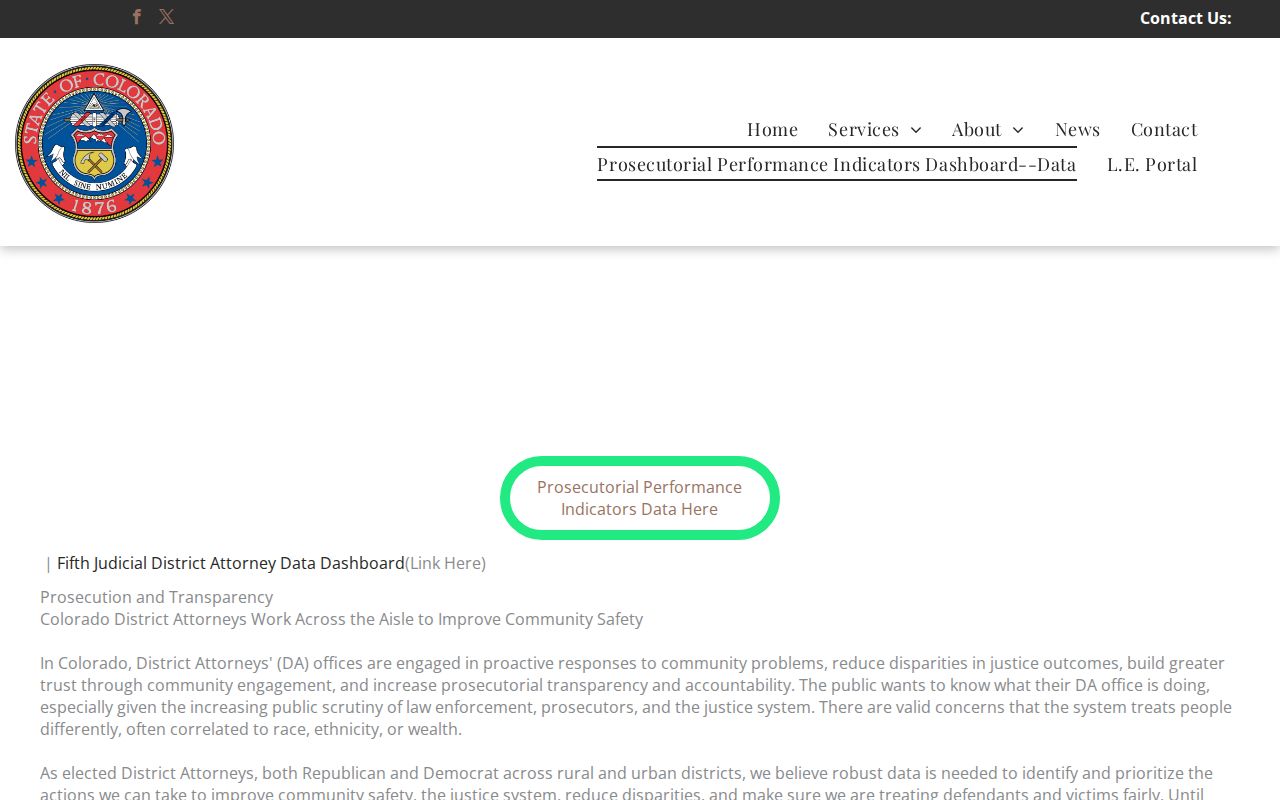
The district also publishes dockets, services, and deadly-force reviews. These materials provide aggregate or case-process context, while the clerk remains the source for an individual filed case.
Eagle Access and Local Context
Eagle's 2024 population estimate is 7,349. Census figures report 29.1 percent Hispanic residents and 25.7 percent under age 18. These figures are not crime rates. They support clear access instructions and careful handling of juvenile and protected data. The town's three-working-day response practice and several contact routes help people who cannot rely on one online tool.
County-seat proximity can create the false idea that all Eagle records sit in one building. They do not. Town police and court questions stay at Broadway. Sheriff, jail, state court, and prosecution questions route to the Chambers Avenue complex. A correct office choice is often more valuable than a broad name search.
Official 2022 reporting lists 560 Eagle Police contacts. That count is not a count of crimes or arrests. A contact can reflect many kinds of service. Use it only as agency workload context, and rely on an individual report, booking, or court file when trying to understand a specific event.
Eagle Record Access Rules
CCJRA governs EPD criminal-justice records. CORA applies to many general town records. Chief Justice Directive 05-01 controls access to Colorado court records. A custodian can release public portions while redacting protected information. Sealed records, juvenile material, victim details, and active-investigation content may not be available through ordinary public inspection.
Key Statutes:
C.R.S. §§ 24-72-301 through 24-72-309 set Colorado criminal-justice record access rules.
C.R.S. §§ 24-72-200.1 through 24-72-206 govern many town administrative records.
Chief Justice Directive 05-01 governs public access to state court records.
Request the narrow record that answers the question. Ask EPD for the narrative, the municipal clerk for the town file, and Eagle Combined Courts for the state case outcome.