
Gypsum State History Limits
CBI history is Colorado-only. It does not replace a federal or out-of-state search, and a public fingerprint review does not include an FBI result. For a known Gypsum event, the local report and court disposition remain the clearest sources. Use ICHC to add statewide context, then read its exclusions before treating a no-result response as proof that no local record exists.
Correcting a Gypsum Record Gap
A mismatch among ECSO, the court, and CBI should be traced to the source that owns the missing fact. If an ICHC report shows an unknown disposition, request the official disposition or sentence order from Eagle Combined Courts. CBI directs the subject to submit official outcome documentation through its disposition-update process. Repeating a paid name search does not fix a reporting gap.
When the issue is identity rather than outcome, compare the exact legal name, birth date, and event details. ICHC tells users to omit suffixes such as Jr. and Sr. It permits an optional Social Security number, while maiden or alias names require separate searches. A fingerprint-based personal record review offers a stronger identity match than narrowing a common name again and again. CABS uses approved IdentoGO and Colorado Fingerprinting vendors for capture.
Local errors follow a different route. Ask ECSO about a deputy report, the jail about a booking field, and the municipal or county clerk about its own docket. Keep the report number, booking identifier, and court case number together. Those identifiers show each custodian which record needs review. A corrected court document can support a CBI update, but CBI cannot rewrite an ECSO narrative or town clerk file.
Gypsum Criminal History Checks
A Gypsum record check starts by defining the event and its custodian. The Eagle County Sheriff's Office, or ECSO, provides the town's police services. It creates the law-enforcement report. Gypsum Municipal Court keeps town traffic, parking, animal, and code cases. Eagle County courts hold state misdemeanor or felony filings. CBI compiles fingerprint-supported Colorado arrest cycles and reported outcomes, but does not hold the deputy's narrative.
Use this five-step path to avoid asking one office for another office's file:
- Contact ECSO for a deputy-created Gypsum incident or arrest report.
- Ask Gypsum Municipal Court about a town citation or local-code case.
- Search Eagle County's free docket, then request the ROA or filed documents for a state case.
- Use the Eagle County Jail Viewer for booking and custody information.
- Run an official CBI ICHC name check for fingerprint-supported Colorado history.
A no-result response at one step is not a final answer. A summons may never create a jail entry. A town citation may stay in municipal court. CBI may omit an arrest that was not fingerprinted or a disposition that was not matched.
Gypsum Records Start With ECSO
Gypsum has no standalone police department. Under the town's 2025 intergovernmental agreement, ECSO provides policing, dispatch, body-worn cameras, and county-jail detention. Deputies work from the first floor of Town Hall at 50 Lundgren Boulevard. This is more than an administrative detail. A request for a deputy report belongs with ECSO even when the event occurred inside Gypsum.
The official Gypsum police services page explains the contracted arrangement. The image below preserves that public starting point.
That arrangement sends Gypsum state-law arrests into the same sheriff, jail, and county-court chain used elsewhere in Eagle County, while town-code citations remain local.
Records at the Gypsum Police Department
The anchor name can be misleading: Gypsum does not operate a police department. For a Gypsum deputy report, contact ECSO through nonemergency dispatch at 970-479-2201 or email info@sheriff.eagle.co.us. Describe the incident date, location, parties, and report number if known. Ask for the legally releasable portion. CBI cannot supply local narrative reports, and the town's general open-records form is not a substitute for an ECSO criminal-justice request.
CCJRA lets the custodian weigh access to criminal-justice records. Active investigation material, victim and minor identifiers, and protected personal data may be redacted or withheld. The jail viewer is another product entirely. It shows custody data, not the deputy's account, evidence references, or final court outcome.
Dispatch and report custody are also distinct. Dispatch can help identify the responsible agency or route a nonemergency call, while the records custodian decides what an existing report may lawfully release. Give enough detail to locate the event, then ask where to send the formal request and whether identity or notarization is required under the current ECSO procedure.
Town CORA or Sheriff CCJRA
Gypsum's webform serves general town records under the Colorado Open Records Act. It asks for the requester's name, street, city, state, ZIP code, phone, email, department, and a description. Use it for town administrative material and municipal records that the town holds. Deputy-created incident and arrest records remain with ECSO under the Colorado Criminal Justice Records Act.
The Gypsum open-records form shows the fields needed for a focused town request.
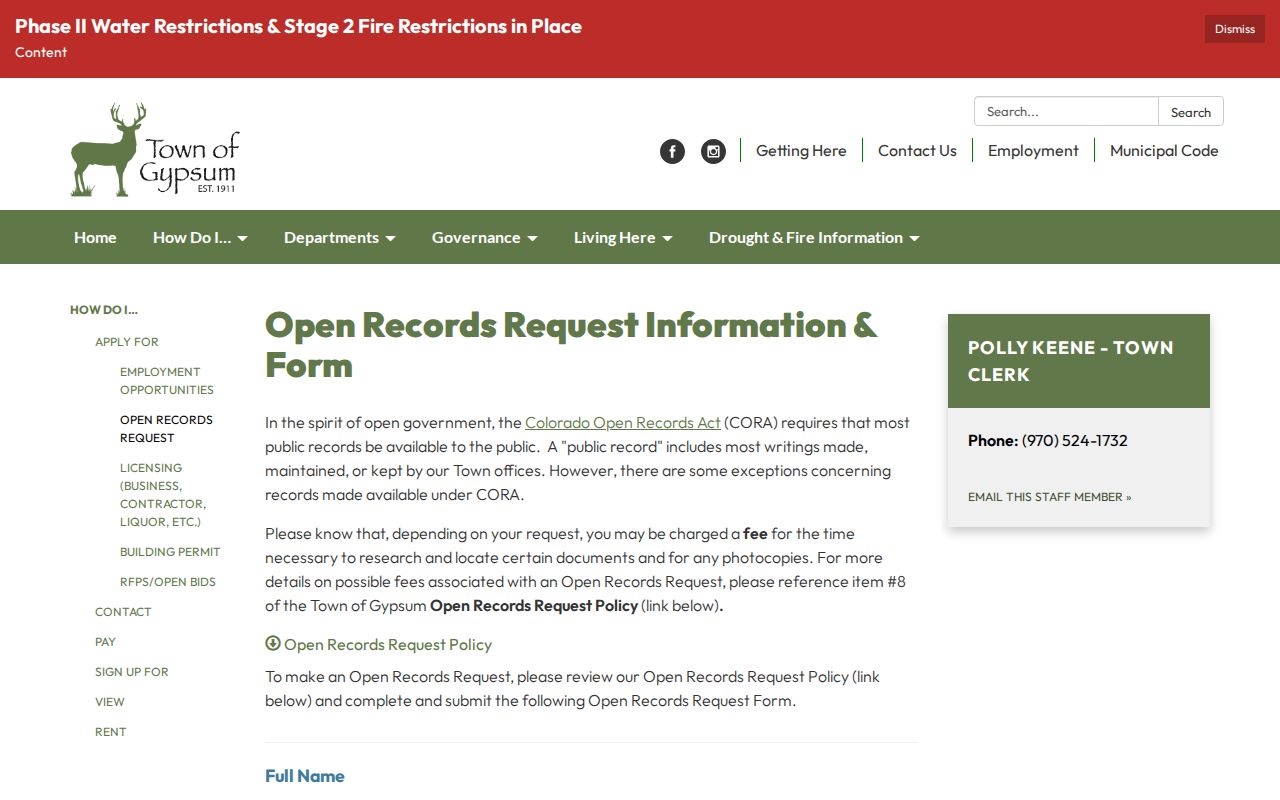
Choosing the correct law and office prevents delay. If the request concerns a deputy's investigation, go to ECSO. If it concerns a town policy, clerk record, or municipal administration, use the town channel.
Booking and Arrest Records in Gypsum
ECSO makes a Gypsum arrest, then books the person into the Eagle County jail when detention is required. Gypsum has no city jail. The county Jail Viewer is the official public channel for custody and booking data. Search options include name, booking number, booking or release date ranges, and status. A percent sign can serve as a wildcard in a name field.
Booking data commonly includes the booking identifier and date, status, intake charges, bond information, and facility data. Those are intake facts. Charges may change after review by the prosecutor. For the filed accusation and outcome, move to the proper court. The broader Eagle County arrest search explains the county booking channel in more depth.
Gypsum Arrests Follow Chambers Avenue
A state-law Gypsum case moves from ECSO to the county justice system in Eagle. The District Attorney decides what to file. County Court handles state misdemeanors and traffic matters, while District Court handles felonies. Eagle Combined Courts then creates the docket, orders, disposition, sentence, and financial entries.
This is why a person may find a recent booking but no court result. Intake comes first. Filing and disposition follow. The free Judicial Branch docket shows hearings, not the complete file. Use the state Record/Document Request form and select Eagle County for the register of actions, complaint or information, disposition or sentence order, ticket, or other available document.
The Gypsum Municipal Court File
Gypsum Municipal Court hears traffic, parking, animal, and town-code matters. Other violations go to Eagle County Court. Court meets on the second Tuesday of each month at 2 p.m. in Town Hall. The clerk can explain the available lookup and copy channel. The court is at 50 Lundgren Boulevard, PO Box 130, Gypsum, CO 81637, and its phone is 970-524-7514.
The official Municipal Court page is the source for the court calendar and contact details.
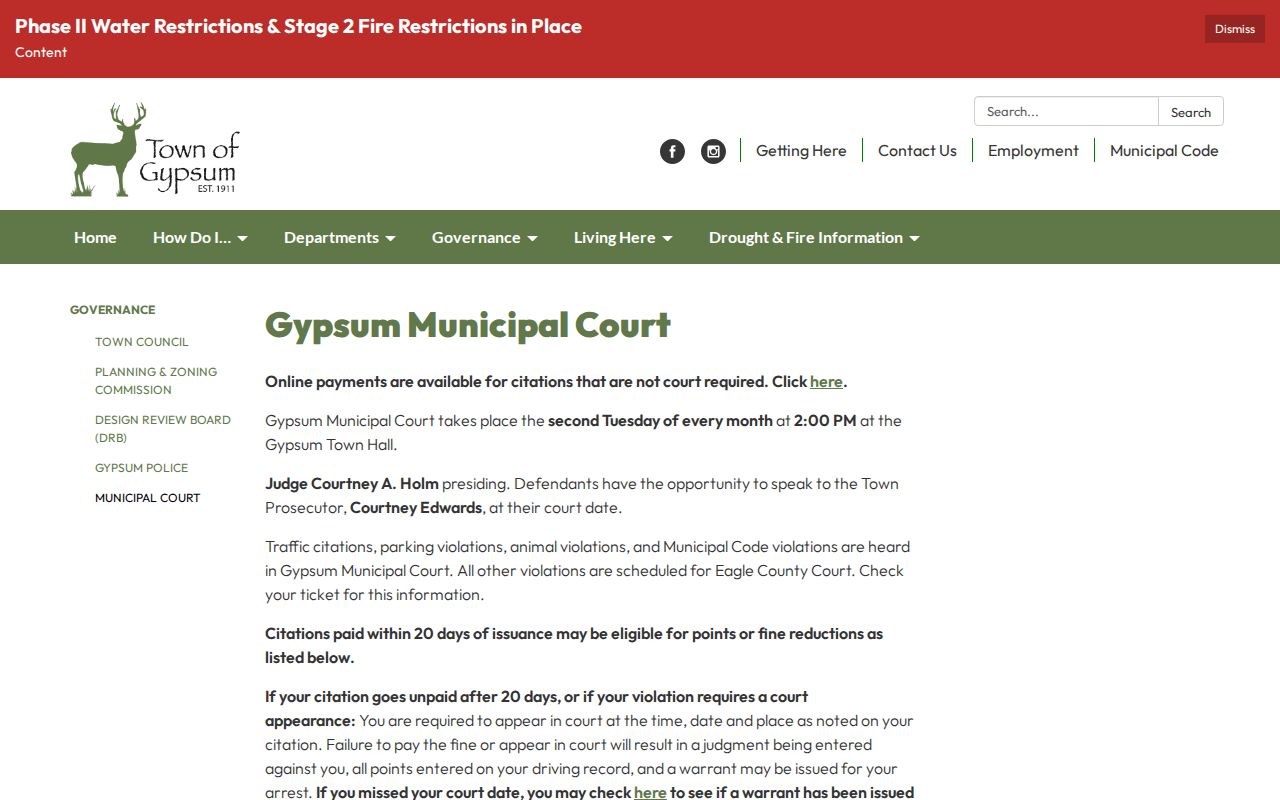
The court warns that nonpayment or failure to act after 20 days can lead to judgment, full points, and a warrant. Contact the clerk rather than assuming an online county docket covers the town file.
| Court Name | Gypsum Municipal Court |
|---|---|
| Case Types Heard | Town-code, traffic, parking, and animal matters |
| Case Lookup Channel | Municipal clerk by phone or at Town Hall |
| What the File Shows | Citation, settings, plea, orders, judgment, and payment status when maintained |
| Copies & Fees | Ask the clerk for the current charge and delivery options |
Gypsum Ticket or State Case
The wording on a citation and the filing office matter. A Gypsum Code violation stays with Municipal Court. A state-law misdemeanor, traffic case, or felony moves to Eagle County's courts. Do not infer venue from the fact that an ECSO deputy issued the citation. Contract policing does not turn every deputy event into a county case.
When the venue is unclear, give the municipal clerk the name, date, and citation details. Then check the Eagle County docket by party, case number, date, court, or division. A case number may include classes such as CR, M, T, or R, but the class code alone does not establish the precise charge or final result.
The register of actions, often called an ROA, is a compact court history. It can list charges, minute orders, sentences, and other docket events. A complaint or information states what prosecutors filed, while the disposition or sentence order records the outcome. Ask for the document that answers the question instead of ordering every page in the file.
How Gypsum Records Reach the County
The original event branches into separate official records. ECSO keeps the report. The jail keeps the custody entry. The prosecutor creates the charging paper, and the court keeps the case outcome. CBI later receives fingerprint-supported arrest and disposition data. Each source answers a different question.
Record flow: Gypsum sheriff services › Eagle County Courts › Colorado Bureau of Investigation
Recent local activity is best checked with ECSO, the jail, and the proper clerk. An older statewide self-review may call for ICHC. ICHC costs $6 per search or viewed matched report, is Colorado-only, and is not notarized. Exact legal name and date of birth matter. Warrants, sealed matters, most juvenile records, and arrests unsupported by fingerprints are excluded.
Gypsum Records and Rapid Growth
Gypsum grew from 8,040 residents in 2020 to an estimated 9,218 in 2024. Census data reports that 54.0 percent of residents identify as Hispanic and 19.6 percent are foreign-born. Those facts make clear request language and practical access channels important. A requester who cannot reach a webform can call dispatch or the municipal clerk and ask what details are needed.
Population figures do not measure crime. They explain service demand and why one counter may route several kinds of questions. Town events such as Gypsum Daze, National Night Out, Gyptober, and Home for Holidays also produce local public-safety work without making every contact a criminal record.
Remote access matters in a mountain county. The town form, phone lines, email, county docket, Jail Viewer, and CBI portal each reduce the need to visit several counters. Still, certified or detailed documents may require a clerk request and a fee. Confirm the delivery method before assuming that a screen result is the official copy.
Gypsum Record Access Rules
Colorado separates criminal-justice records, general government records, and court files. CCJRA governs ECSO reports. CORA governs many town administrative records. Chief Justice Directive 05-01 governs court access. Public does not mean every line must be released. The custodian may protect victims, minors, active investigations, sealed cases, and other restricted data.
Key Statutes:
C.R.S. §§ 24-72-301 through 24-72-309 govern access to Colorado criminal-justice records.
C.R.S. §§ 24-72-200.1 through 24-72-206 govern many general town records under CORA.
Chief Justice Directive 05-01 sets the access framework for Colorado court records.
Ask for a releasable copy instead of demanding an entire investigative file. If CBI history lacks a final outcome, get official proof from the court or agency and use CBI's disposition-update process.